



FAQ's
Why are tigers’ part of Kishindo’s work in South Africa?
Kishindo’s tiger work began as an exploration of whether captive-born tigers could live in a large, managed landscape with space, challenge, and agency. That history remains part of our context. Today, tigers remain here under lifetime care, and our focus is welfare-first management, careful observation, and sharing learning in collaboration with independent partners where it may be useful to wider big-cat stewardship.
What is Kishindo’s purpose and conservation focus today?
Kishindo is a multi-species conservation reserve grounded in ethical wildlife management, landscape restoration, and science-informed monitoring. Alongside lifetime care for our tigers, our in-situ work includes cheetah conservation in partnership with established organisations, as well as broader habitat recovery that supports indigenous wildlife and biodiversity.
What does “ex situ” mean in your tiger work?
“Ex situ” means conservation work that happens outside a species’ original range. In our context, it refers to tigers living on protected land in South Africa under managed, welfare-first conditions. It does not replace the vital in-situ work of protecting wild tigers and habitat in Asia; it is a parallel setting focused on care, observation, and responsible learning.
What do you mean by “managed-wild” at Kishindo?
Managed-wild means animals live in a large landscape where they can express natural movement and behaviour, while being supported by clear rules, monitoring, and welfare oversight. Management is used to reduce unnecessary risk, respond appropriately when welfare is compromised, and maintain safe, respectful boundaries between people and wildlife.
What wildlife can guests see at Kishindo besides tigers?
Kishindo is a restored and recovering Karoo landscape with a wide range of wildlife and birdlife. Guests commonly see plains game such as springbok, red hartebeest, and zebra, as well as a variety of raptors and other species linked to grassland, wetland, and rocky-outcrop habitats. Night observations may also reveal smaller, nocturnal species that are easily missed in daylight.
How does cheetah conservation work at Kishindo?
Our cheetah work is delivered through a dedicated programme in collaboration with the Endangered Wildlife Trust (EWT) and the Cheetah Metapopulation Initiative (TCMI). The focus is on responsible management and monitoring that supports long-term population resilience across connected conservation areas, with careful record-keeping that helps inform management decisions.
What is “cheetah tracking and observation” for guests?
When conditions allow, guests may take part in guided tracking and observation sessions under strict protocols. These experiences are designed around calm viewing, animal choice, and learning to read behaviour in real time. The goal is always to minimise pressure on the animals while deepening guest understanding of cheetah ecology and movement.
How do tiger safaris work at Kishindo?
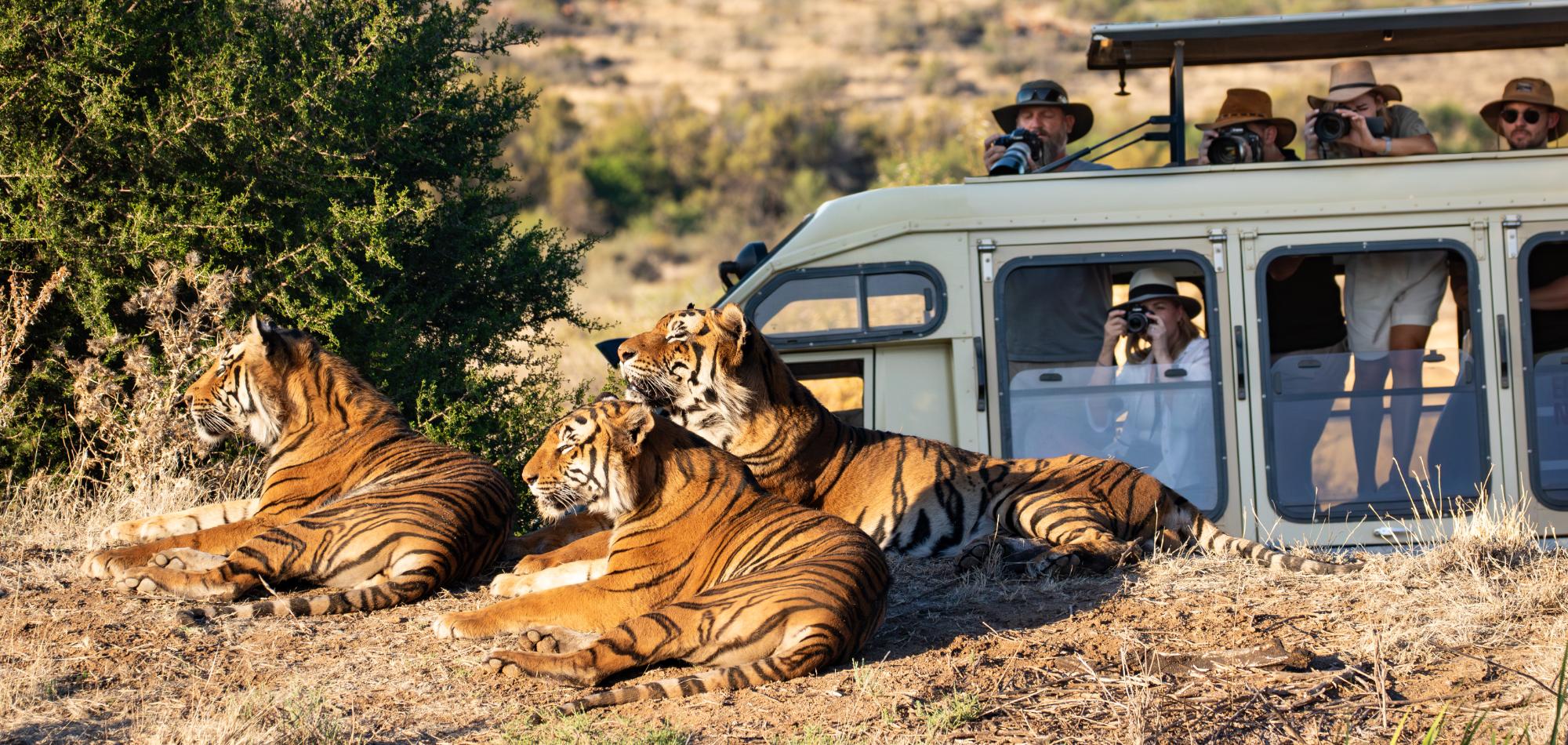
Tiger viewing takes place from secure, enclosed safari vehicles. This approach supports calm observation while prioritising safety and animal welfare in a managed-wild system. We manage viewing numbers per sighting: most sightings are shared by two vehicles, with an occasional third when appropriate, and additional restrictions apply around mothers with young cubs.
Weather & What to Pack
To stay comfortable at Kishindo Tiger Canyon, we recommend packing according to the season — and always planning for cooler mornings and evenings.
October – April (Spring / Summer)
Days are generally warm and sunny, with cooler temperatures in the early mornings and evenings.
Pack: light summer clothing (shorts, skirts, breathable shirts), a hat, sunglasses, sunscreen, and a warm jacket or fleece for evening game drives.
Mid-summer (December) can be hot, with temperatures sometimes reaching 35°C or higher. Air conditioning is available in the lodge.
May – September (Autumn / Winter)
Days are often sunny and mild, but mornings and evenings can be very cold.
Pack: light layers for daytime, plus a very warm jersey/fleece, a winter jacket, beanie, gloves, and closed shoes for cold starts.
Mid-winter (July–August) can drop as low as -5°C on some nights. Each room has a fireplace, and our vehicles are closed for comfort during extreme weather.
Year-round essentials
Comfortable walking shoes, a small day bag, reusable water bottle, insect repellent (seasonal), and a camera/phone charger (plus power bank if you use one).
Best Time to go on Safari
Southern Africa can be enjoyed year-round, and each season offers something different. Traditionally, the drier winter months (roughly May to October) are considered best for game viewing because grasses are shorter, there’s less foliage, and wildlife often gathers closer to reliable water sources—making sightings easier.
Kishindo Tiger Canyon lies in a semi-arid region with low annual rainfall. When rain does arrive, it’s often in the form of short afternoon thundershowers from December to March. This greener period brings its own rewards: many mammals time births around the start of the rains, so the reserve can feel especially lively with newborn animals and changing seasonal activity.
What to Bring
We recommend packing the following:
- Clothing: Lightweight cotton clothing in neutral colours for game drives and walks. Formal wear is not required.
- Footwear: Comfortable walking shoes, and sandals for around the lodge. If you intend going on the Canyon pools Hiking trail, robust walking shoes or hiking boots are recommended.
- Sun & swim: Swimming costume, sunscreen, sunhat, sunglasses, and lip balm.
- Gear: Camera/phone, binoculars, spare memory cards, chargers, and a power bank if you use one.
- Drones: The use of unmanned aerial vehicles (drones) is strictly prohibited at Kishindo.
- Personal essentials: As the lodge is in a remote area, please bring a spare pair of prescription glasses (and/or contact lenses with solution if needed), as well as a sufficient supply of any prescription medication.
Health & Travel
- Medical facilities: Kishindo is remote. Please note the nearest doctor and pharmacy are about 2.5 hours away by road.
- Malaria
Kishindo is situated in a malaria-free area, so anti-malarial medication is not required for travel here. If you have specific health concerns, we still recommend checking with your healthcare provider. - Passports
To enter South Africa, your passport should be valid for at least 30 days beyond your intended departure date from South Africa, and you must have at least two consecutive blank visa pages per entry (endorsement/observations pages do not count). You may be refused entry if these requirements aren’t met. - Visas
Visa requirements depend on your nationality and length of stay. Many travellers (including S. passport holders) do not need a visa for tourism or business stays of up to 90 days, but requirements can change—please confirm the rules for your passport well before departure using official South African sources or your nearest South African embassy/consulate. - Travel Insurance
We strongly recommend comprehensive travel insurance to protect your trip investment and to cover delays, cancellations, and interruptions, as well as medical care and evacuation where applicable.
Should I take precautions against malaria?
Kishindo Tiger Canyon falls well outside of South Africa’s malaria areas, therefore there is no need for concern.
Can I book Kishindo Tiger Canyon for exclusive use?
Yes. Kishindo Canyon Lodge can be booked for exclusive use and is ideal for a family or small group of friends seeking a fully private, exclusive safari experience
What is Kishindo’s child policy?
For safety reasons, Kishindo can only accommodate children 10 years and older. Certain areas of the lodge and aspects of vehicle-based activities are not suitable for younger children.
What is the dining experience like? Can you cater for different dietary preferences?
Kishindo Canyon Lodge offers a thoughtful balance of fine dining and relaxed, homestyle cooking. We’re happy to accommodate dietary preferences and requirements with advance notice.
In addition to meals served at the lodge, guests can also enjoy dining outdoors at our designated bush picnic spots — either overlooking the impressive Vanderkloof Dam or taking in the wide-open Kishindo landscape.
What is the weather like and what is the best time of the year to visit?
Kishindo enjoys generally clear, pleasant weather throughout the year, with a semi-arid climate there can be large temperature shifts between day and night. Winter (June–August) brings crisp early mornings and very cold evenings, while daytime temperatures are often comfortably mild and sunny. For added comfort in colder conditions, our game-drive vehicles are enclosed and blankets are provided.
Many guests find the most comfortable times to visit are autumn and spring — March to May and September to November — when temperatures are typically moderate and conditions are ideal for both activities and relaxation.
Is Kishindo open to day visitors?
Yes, depending on the availability of our guides. We do not allow self-drive safaris. For more information and to book the day visitors offer, please contact us for more details.
What is the best way to travel to Kishindo Tiger Canyon?
By air: Fly commercially to Bloemfontein Airport, then enjoy a ±2½-hour road transfer to the reserve. Alternatively, you can charter a flight to the Gariep Dam tar airstrip, followed by a ±1-hour road transfer.
By road: You are welcome to self-drive, or our reservations team can arrange a transfer for you.
For more details, including directions and transfer options, please see our Contact Us / Travel Info page.
Kishindo Policies and Protocols
Animal Welfare and Guest Conduct
- No hands-on interaction: We do not allow cub petting or any form of physical interaction with wildlife.
- Wild animals remain wild: Our guiding and guest conduct rules are designed to protect animals natural behaviour and reduce stress.
- Welfare-first decision-making: Animals are monitored closely. Intervention is guided by veterinary judgement and used when welfare is compromised.
Tiger Safari Protocols
- Enclosed vehicles only: Tiger viewing is conducted from custom enclosed vehicles.
- No one outside the vehicle in tiger areas: Guests always remain inside the vehicle during tiger viewing.
- No walking activities in tiger areas: On-foot activities do not take place in tiger zones.
- Low-density viewing per sighting: Most sightings involve two vehicles, with an occasional third when appropriate.
- Extra protection for cubs: Mothers with young cubs are viewed with stricter limits (typically one vehicle when appropriate).
- Calm viewing standards: Guides prioritise quiet approaches, respectful distance, and time-based viewing that avoids pressure on the animals.
Cheetah Tracking and Observation Protocols
- Protocol-led and conditions-based: Tracking and observation sessions take place only when conditions support calm, respectful viewing.
- Animal choice comes first: If a cheetah shows sensitivity or chooses distance, guides adjust immediately.
- Behaviour-led guiding: Guests are guided to observe posture, movement, scanning, and social signals, rather than “pushing for a closer look.”
- Responsible positioning: Viewing is managed to reduce stress and avoid disrupting hunting, resting, or social dynamics.
Ethical Boundaries
- No hunting of any kind.
- No staged interactions for photographs.
- Respectful storytelling: We encourage photography and sharing that reflects animal dignity and accurate context.
Opposition to wildlife exploitation
Kishindo supports efforts to end the exploitation of wildlife for profit, including canned lion hunting and the illegal trade in wildlife and wildlife products (including for traditional medicine), as well as the illegal pet trade. We support strong regulation, enforcement, and ethical, welfare-first conservation practice.